ラベル Book の投稿を表示しています。 すべての投稿を表示

2021年10月15日金曜日

Polemical and Exegetical Polarities in Medieval Jewish Cultures Studies: in Honour of Daniel J. Lasker

Polemical and Exegetical Polarities in Medieval Jewish Cultures

in Honour of Daniel J. Lasker

Edited by: Ehud Krinis, Nabih Bashir, Sara Offenberg and Shalom Sadik

De Gruyter, 2021

Table of Contens:

Frontmatter I
Acknowledgement VII
Contents IX

I ON DANIEL J. LASKER AND HIS SCHOLARSHIP

Prof. Daniel J. Lasker – Scholar, Teacher, and Friend
Howard Kreisel 1

Daniel J. Lasker and His Treatment of Jewish Polemics
Shalom Sadik 9

List of Publications
Daniel J. Lasker 19

II JEWISH POLEMICS AND EXEGESIS IN THE ISLAMICATE WORLD

Polemical Logic: Al-Muqammaṣ’s Refutation of Christianity
Sarah Stroumsa 37

The Role of Gog in Daniel al-Qūmisī’s Eschatology
Barry Dov Walfish and Meira Polliack 59

Theological Consideration of the Gift of the Land and the Radical Treatment of the “Seven Nations” in Medieval Judeo-Arabic Exegesis
Haggai Ben-Shammai 77

Epistemology in the Service of Polemic: Yūsuf al-Baṣīr’s Kitāb al-Istiʿānah: Text and Translation
David Sklare 97

Maimonides on the Status of Judaism
Matanel Bareli and Menachem Kellner 135

Abraham Maimonides on Reclaiming Judaism’s Lost “Perfection” from the “Imperfection” of Islam
Mordechai Akiva Friedman 165

III JEWISH AND ANTI-JEWISH POLEMIC AND EXEGESIS IN THE CHRISTIAN WORLD

Abraham bar Ḥiyya (d. ca. 1136) on “The Pure Soul”
Ehud Krinis 201

Asmakhtaʾ and Abraham ibn Ezra’s Exegesis
Martin Lockshin 229

The Finding of the “True Cross” in Judah Hadassi’s Eškol ha-Kofer and the Polemical Parody Toledot Yešu
Miriam Goldstein 251

The Book of Nestor the Priest and the Toledot Yešu in the Polemics of Abner of Burgos/Alfonso of Valladolid
Ryan Szpiech 269

Rashi on Isaiah 53: Exegetical Judgment or Response to the Crusade?
David Berger 301

“The Best of Snakes. . .”: A Polemical Midrash in the Rashi Supercommentary Tradition
Eric Lawee 317

The Discussion of the Messiah in Crescas’s Refutation
Warren Zev Harvey 347

Joshua Ha-Lorki on the Meaning of Emunah: Between Religion and Faith
Yosi Yisraeli 363

Jewish Anti-Semites: The Case of Medieval Apostates
Shalom Sadik 383

Daniel in the Lions’ Den: Jewish-Christian Polemics in Medieval Text and Image
Sara Offenberg 413

IV JEWISH-JEWISH AND JEWISH-CHRISTIAN RELATIONS

Understanding the Uneven Reception of Rabbenu Tam’s Taqqanot
Ephraim Kanarfogel 437

Ritual Imagery Gone Wrong: A Fifteenth-Century Siddur in a Christian Workshop
Katrin Kogman-Appel 467

Transliteration Charts 507
Index of Names 509

2021年1月3日日曜日

New Books on Moses Nahmanides by Moshe Halbertal [English] & Oded Yisraeli [Hebrew]

Moshe Halbertal, Nahmanides: Law & Mysticism
Yale University Press, 2020

Contents
Introduction
1: Nahmanides's Philosophy of Halakhah
2: Custom and the History of Halakhah
3: Death, Sin, Law, and Redemption
4: Miracles and the Chain of Being
5: Revelation and Prophecy
6: Nahmaides's Conception of History
7: The Reasons for the Commandments
8: Esotericism and Tradition
Conclusion: Nahmanides between Ashkenaz and Andalusia


עודד ישארלי, ר' משה בן נחמן: ביוגרפיה אינטלקטואלית
מאגנס, תשע"א
(Oded Yisraeli, R. Moshe ben Nahman: Intellectual Biography)

תוכן העניינים
מבוא
פרק ראשון: רמב"ן - זמנו ומקומו
פרק שני: ראשית ביכורים - היצירה התלמודית-ההלכתית
פרק שלישי: בעין הסערה - פולמוס הרמב"ם וראשית היצירה ההגותית
פרק רביעי: על פרשת דרכים - ההתכנסות אל פירוש התורה: אפיונים ומגמות
פרק חמישי: מנגלה לנסתר - פירושי רמב"ן "על דרך האמת
פרק שישי: קבלת רמב"ן - התהוות, התגשמות, התחבטות
פרק שביעי: "כוונת כל המצוות" - עבודת האלוהים ןתכליתה בעולמו של רמב"ן
פרק שמיני: בסבך הפולמוס היהודי-הנוצרי - וויכוח ברצלונה ומשנתו המשיחית של רמב"ן
פרק תשיעי: רמב"ן בארץ ישראל - יצירתו ועולמו הדתי באחרית ימיו
אחרית דבר


2020年6月26日金曜日

E. Alexander & B. Berkowitz (eds), Religious Studies and Rabbinics: A Conversation

Religious Studies and Rabbinics: A Conversation
Elizabeth Alexander, Beth Berkowitz eds.
Routledge, 2017

Contents
Introduction – Elizabeth Shanks Alexander
Part I: The History of Religion
1. Religious Studies, Past and Present – Randall Styers
2. Different Religions? Big and Little "Religion" in Rabbinics and Religious Studies – Beth A. Berkowitz
3. J.Z. Smith on the Study of Religion, Humanities and Human Nature – Kurtis R. Schaeffer

Part II: Managing Commitments
4. "A Cheerful Unease": Theology and Religious Studies – Paul Dafydd Jones
5. Reading Midrash as Theological Practice – Deborah Barer
6. Alexandria between Athens and Jerusalem: Religious Studies as a Humanistic Discipline – Charles Mathewes

Part III: Comparative Rubrics and Rabbinic Data
7. The Legal Language of Everyday Life in Rabbinic Religion – Chaya Halberstam
8. Time, Gender and Ritual in Rabbinic Sources – Sarit Kattan Gribetz
9. Ritual Failure, Ritual Success, and What Makes Ritual Meaningful in the Mishnah – Naftali S. Cohn

Part IV: Critical Reading
10.Thou Shalt Not Cook a Bird in its Mother’s Milk?: Theorizing the Evolution of a Rabbinic Regulation – Jordan D. Roseblum
11. Learning How to Read: How Rabbinics Aids in the Study of Contemporary Christian Scripture-Reading Practices
12. From the General to the Specific: A Genealogy of "Acts of Reciprocal Kindness" (Gemilut Hasidim) in Rabbinic Literature – Gregg E. Gardner

Information on the book
https://www.routledge.com/Religious-Studies-and-Rabbinics-A-Conversation/Alexander-Berkowitz/p/book/9781138288805

Book review (from Ancient Jew Review)
https://www.ancientjewreview.com/articles/2020/6/15/religious-studies-and-rabbinics?fbclid=IwAR3MQvm1u1AuvlItGssvunXXAl71HzKLXQLuA9SSQfrAbdPQLGMbQAkVFXM

2018年10月17日水曜日

BOOK The Cambridge History of Judaism, Volume 6, The Middle Ages: The Christian World

The Cambridge History of Judaism
Volume 6, The Middle Ages: The Christian World
Edited by Robert Chazan (New York University)
Cambridge: Cambridge University Press, 2018

Contents
Introduction
by Robert Chazan

Part I - Jews in the Medieval Christian World

Chapter 1 - The Prior Church Legacy
by Robert Chazan
Chapter 2 - Medieval Church Doctrines and Politics
by Anna Sapir Abulafia
Chapter 3 - Mutual Perceptions and Attitudes
by David Berger
Chapter 4 - Byzantium
by Nicholas De Lange
Chapter 5 - Italy
by David Abulafia & Robert Bonfil
Chapter 6 - The Iberian Peninsula
by Yom Tov Assis & Mark Meyerson
Chapter 7 - Southern France
by Ram Ben-Shalom
Chapter 8 - Northwestern Europe
by Robert Chazan
Chapter 9 - Germany
by Alfred Haverkamp
Chapter 10 - Northeastern Europe
by Nora Berend

Part II - Social and Institutional History
Chapter 11 - The Sources
by Ephraim Shoham-Steiner
Chapter 12 - Demography and Migrations
by Michael Toch
Chapter 13 - Economic Activities
by Michael Toch
Chapter 14 - Communal and Religious Organization
by Jeffrey Woolf
Chapter 15 - Schools and Education
by Ephraim Kanarfogel
Chapter 16 - Annual Cycle and Life Cycle
by Elisheva Baumgarten
Chapter 17 - The Family
by Elisheva Baumgarten

Part III - Spiritual and Intellectual History
Chapter 18 - The Sources
by Daniel J. Lasker
Chapter 19 - Languages and Translations
by David M. Bunis & James T. Robinson
Chapter 20 - Book Production
by Malachi Beit-Arie
Chapter 21 - Bible Studies
by Martin Lockshin
Chapter 22 - Talmudic Studies
by Ephraim Kanarfogel
Chapter 23 - Jewish Law
by Alyssa M. Gray
Chapter 24 - Liturgy and Piyut
by Stefan C. Reif & Elisabeth Hollender
Chapter 25 - Philosophy
by Mauro Zonta
Chapter 26 - Science and Medicine
by Gad Freudenthal
Chapter 27 - Mysticism
by Elliot R. Wolfson
Chapter 28 - Belles-Lettres
by Jonathan P. Decter
Chapter 29 - Polemics
by Daniel J. Lasker
Chapter 30 - Historiography
by Eva Haverkamp
Chapter 31 - Material Culture and Art
by Katrin Kogman-Appel

Suggested Readings
Index

Book Description
Volume 6 examines the history of Judaism during the second half of the Middle Ages. Through the first half of the Middle Ages, the Jewish communities of western Christendom lagged well behind those of eastern Christendom and the even more impressive Jewries of the Islamic world. As Western Christendom began its remarkable surge forward in the eleventh century, this progress had an impact on the Jewish minority as well. The older Jewries of southern Europe grew and became more productive in every sense. Even more strikingly, a new set of Jewries were created across northern Europe, when this undeveloped area was strengthened demographically, economically, militarily, and culturally. From the smallest and weakest of the world's Jewish centers in the year 1000, the Jewish communities of western Christendom emerged - despite considerable obstacles - as the world's dominant Jewish center by the end of the Middle Ages. This demographic, economic, cultural, and spiritual dominance was maintained down into modernity.

Website of the Cambridge History of Judaism
https://www.cambridge.org/core/books/cambridge-history-of-judaism/3407B39B6C4F921F2FA8C265032A415B

Published in the Cambridge History of Judaism Series
Volume 1, Introduction: The Persian Period
Volume 2, The Hellenistic Age
Volume 3, The Early Roman Period
Volume 4, The Late Roman-Rabbinic Period
Volume 6, The Christian World
Volume 7, The Early Modern World, 1500-1815
Volume 8, The Modern World, 1815-2000

2015年12月4日金曜日

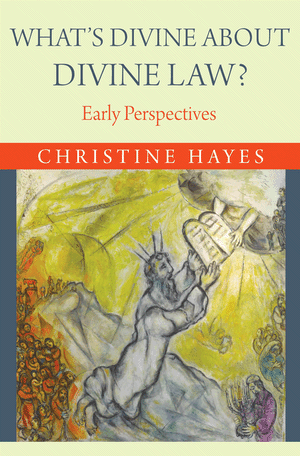
Hayes, What's Divine about Divine Law?

Christine Hayes, What's Divine about Divine Law? -Early Perspectives
Princeton: Princeton University Press, 2015

Contents

Acknowledgments
Abbreviations

Introduction
What's So Divine about Divine Law?
Part I—­Two Conceptions of Divine Law
Parts II and III—Three Responses
 Part II—Mosaic Law in the Light of Greco-­Roman Discourses of Law: Ancient Jewish Responses to the End of the First Century CE
 Part III—The Rabbinic Construction of Divine Law


Part I Biblical and Greco-Roman Discourses of Divine Law
Introduction
1 Biblical Discourses of Divine Law
Introduction
Discourses of the Law
 Discourse 1: Divine Law as an Expression of Divine Will
 Discourse 2: Divine Law as an Expression of Divine Reason
 Discourse 3: Divine Law and Historical Narrative
The Multidimensionality of Biblical Divine Law

2 Greco-­Roman Discourses of Law
Discourses of Natural Law
 Discourse 1: Natural Law and Truth—Logos and Realism
 Discourse 2: Natural Law and Cosmopolitanism
Discourses of Human Positive Law
 Discourse 3: Law and Virtue—the Inadequacy of Positive Law
 Discourse 4: The Flexible, Unwritten, "Living Law" vs. the Inflexible, Written, "Dead Letter"
 Discourse 5: The Opposition of Phusis and Nomos?
 Discourse 6: Positive Law in Need of a Savior
 Discourse 7: In Praise of Written Law—the Mark of the Free, Civilized Man
Additional Literary and Legal Practices: The Juxtaposition of Divine and Human Law
 (8) Divine Law as a Standard for the Evaluation of Human Law
 (9) In the Trenches—Juristic Theory vs. Juristic Practice
 (10) Magistrates and the Equitable Adjustment of Roman Civil Law
Conclusion


Part II Mosaic Law in the Light of Greco-Roman Discourses of Law to the End of the First Century CE
Introduction
3 Bridging the Gap: Divine Law in Hellenistic and Second Temple Jewish Sources
Bridging the Gap
 The Correlation of Torah and Wisdom and the Mutual Transfer of Properties: Sirach, 1 Enoch, and Qumran
 The Correlation of Torah and Reason and the Transfer of Properties: Aristeas, 4 Maccabees, and Philo
Strategies for Negotiating Universalism and Particularism
 Esoteric vs. Exoteric Wisdom: Law’s Narrative in Sirach, 1 Enoch, Qumran, and Philo
Conclusion

4 Minding the Gap: Paul
Paul and the Law
 Genealogical Definition of Jewish Identity: Circumcision and the Law
 Paul’s Discourse of Ambivalence regarding the Mosiac Law
Conclusion


Part III The Rabbinic Construction of Divine Law
Introduction
5 The "Truth" about Torah
What Is Truth?
Measures of Authenticity
 Measure 1: Formal Truth
 Measure 2: Judicial Truth—Human Compromise and Divine Judgment
 Measure 3: Ontological Truth—­Realism vs. Nominalism
The Gaze of the Other
 Rabbinic Self-Awareness: The Motif of Mockery
Conclusion

6 The (Ir)rationality of Torah
Making the Case for the Law's Irrationality
Response 1: Conceding and Transvaluing the Premise
Response 2: Disowning the Premise
Response 3: Denying the Premise—­Rationalist Apologetics
Ta'amei ha-Mitzvot/Ta'amei Torah
Response 4: Splitting the Difference—an Acute Sense of Audience
Conclusion

7 The Flexibility of Torah
Legislative Mechanisms of Change—a Rhetoric of Disclosure?
 Uprooting Torah Law
 Uprooting Torah Law in Light of the Praetorian Edict
Nonlegislative Mechanisms of Change—a Rhetoric of Concealment?
 Modification of the Law—­Internal Values
 Modification of the Law—­External Values
Moral Critique and Phronesis
Conclusion

8 Natural Law in Rabbinic Sources?
Normativity before the Law
 Law Precedes Sinai
 Sinaitic Law Begins at Sinai
 Accounting for Diverse Rabbinic Views on Pre-­Sinai Normativity
The Noahide Laws
 Are the Noahide Laws Invariable, Universal, Rational, and Embedded in Nature?
Conclusion

Writing the Next Chapters
Bibliography
Index of Primary Sources
General Index

http://press.princeton.edu/titles/10509.html

2015年3月11日水曜日

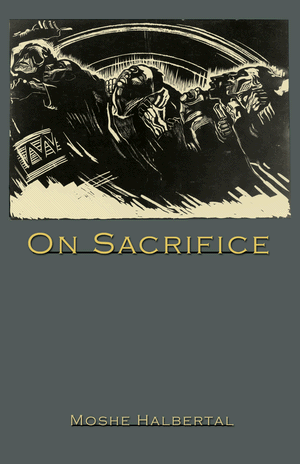
Book: M. Halbertal, On Sacrifice

Moshe Halbertal
On Sacrifice

Princeton: Princeton University Press, 2012

Contents

Introduction

Part 1 SACRIFICING TO
Offering, Rejection, and Ritual
Sacrifice, Exchange, and Love
Sacrifice and Its Substitutes

Part II SACRIFICING FOR
Self-Trancendence and Violence
War and the Sacrificial Logic
Sacrifice and the Political Bond
The State and the Sacrificial Stage

Conclusion

Notes
Index

2015年1月15日木曜日

ספר: אברהם מלמד, דת: מחוק לאמונה

אברהם מלמד
דת: מחוק לאמונה

Abraham Melamed, Dat: From Law to Religion
הוצאת הקיבוץ המאוחד
2014

הספר דת: מחוק לאמונה דן בהתפתחות והשתנות המשמעויות שהוטענו במילה הפרסית במקורה 'דת', שחדרה לראשונה לשפה העברית במגילת אסתר. לאורך תקופות ארוכות היה במילה זו שימוש שולי למדי, למשל בתלמוד הבבלי. רק עם ימי הביניים הפך מינוח זה להיות פופולרי, אך הוא שינה משמעות לאורך התקופות. בספרות העברית של ימי הביניים הוא סימן בדרך כלל 'חוק' במשמעו הכולל, כל חוק, לא רק החוק האלוהי אלא גם החוק האנושי. הייתה זו מילה נרדפת ל'תורה' ו'נימוס'; כולם סימנו חוק כפשוטו, על תת הסוגים שלו. באחרית ימי הביניים אף הופיעה הטענה הרדיקלית כי המילה 'דת' מסמנת אך ורק חוק אנושי, ולכן אין זה מן הראוי לעשות בה שימוש כדי לסמן את החוק האלוהי. עם ראשית העת החדשה החלה המשמעות בה שימשה מילה זו להשתנות, זאת בהשפעת המשמעות הנוצרית החדשה שהוטענה במילה הלטינית religio שהפכה להיות ה-  religion  המודרני. תהליך זה מגיע לשיאו בתקופת ההשכלה כאשר המילה העברית 'דת' מסמנת מעתה religion- , ומשנה משמעות מחוק לאמונה. זו המשמעות המודרנית של מילה זו. משמעותה המקורית כ'חוק' נעלמת והולכת, והמילים 'דת' 'תורה' ו'נימוס', שהיו עד כה מילים נרדפות, מקבלות כל אחת משמעות שונה והולכות לדרכן הנפרדת. התפתחות לשונית זו באה היטב לידי ביטוי במילונאות המודרנית. בתקופתנו מקבלת המילה 'דת' משמעות אמורפית יותר ויותר והיא משמשת לתיאור כל תפיסת עולם מחייבת, גם כזו שאין לה שום הקשר תיאולוגי. שינויי המשמעות של המילה 'דת' לאורך ההיסטוריה, הנסקרים בספר זה, מדגימים היטב את השינוי המשמעותי שעברה היהדות המודרנית מדת המתבססת על חוק לדת המתבססת על אמונה. 

2013年7月21日日曜日

Simania: site for researching Israeli books

Simania

site for researching Israeli books (in Hebrew)

http://simania.co.il/

*検索した古書を売っている古書店も表示

2013年7月1日月曜日

Book: Studies in Medieval Jewish Intellectual and Social History

Studies in Medieval Jewish Intellectual and Social History
Festschrift in Honor of Robert Chazan

edited by
David Engel
Lawrence Schiffmann
Elliot Wolfson

Leiden: Brill, 2012

Table of Contents

Introduction (by David Engel, Lawrence H. Schiffman and Elliot Wolfson)

Guilbert of Nogent and William of Flay and the Problem of Jewish Conversion at the Time of the First Crusade (by Anna Sapir-Abulafia)

Rashi's Choice: The Humash Commentary as Rewritten Midrash (by Ivan G. Marcus)

The Commentary of Rashi on Isaiah and the Jewish-Christian Debate (by Avraham Grossman)

Were Jews Made in the Image of God? Christian Perspectives and Jewish Existence in Medieval Europe (by Brigitte Miriam Bedos-Rezak)

Jewish Knowledge of Christianity in the Twelfth and Thirteenth Centuries (by Daniel Lasker)

Dreams as a Determinant of Jewish Law and Practice in Northern Europe during the High Middle Ages (by Ephraim Kanarfogel)

Orality and Literacy: The French Tosaphists (by Gerard Nahon)

Torah and the Messianic Age: The Polemical and Exegetical History of a Rabbinic Text (by David Berger)

Textual Flesh, Incarnation, and the Imaginal Body: Abraham Abulafia's Polemic with Christianity (by Elliot R. Wolfson)

The Jewish Cemeteries of France after the Expulsion of 1306 (by William Chester Jordan)

The Cruel Jewish Father: From Miracle to Murder (by Kenneth Stow)

From Solomon bar Samson to Solomon ibn Verga: Tales and Ideas of Jewish Martyrdom in Shevet Yehudah (by Jeremy Cohen)

Salo Baron's View of the Middle Ages in Jewish History: Early Sources (by David Engel)

Bibliography of the Works of Robert Chazan (by Yechiel Schur)


2013年6月26日水曜日

Book: New Perspectives on Jewish-Christian Relations (Brill, 2012)

New Perspectives on Jewish-Christian Relations
In Honor of David Berger

Edited by
Elisheva Carlebach
Jacob J. Schacter

Leiden: Brill, 2012


Table of Contents

Acknowledgments
Introduction (by Elisheva Carlebach and Jacob J. Schacter)

CHRISTIAN TRIUMPHALISM AND ANTI-JEWISH VIOLENCE
On the Authenticity of the Testimonium Flavianum Attributed to Josephus (by Louis H. Feldman)
The Menorah and the Cross: Historiographical Reflections on a Recent Discovery from Laodicea on the Lycus (by Steven Fine)
Judaizing the Passion: The Case of the Crown of Thorns in the Middle Ages (by William Chester Jordan)
"Unless the Lord Watches Over the City...": Joan of Aragon and His Jews, June-October 1391 (by Benjamin R. Gampel)

CHRISTIAN MISSION AND JEWISH CONVERSION
Genesis 49:10 in Thirteenth-Century Christian Missionizing (by Robert Chazan)
The Different Hebrew Versions of the "Talmud Trial" of 1240 in Paris (by Judah Galinsky)
An Infant's Missionary Sermon Addressed to the Jews of Rome in 1553 (by Robert Bonfil)
Rabbi Jonathan Eibeschuetz and the Alleged Jewish-Christian Sect in Eighteenth-Century Amsterdam (by Sid Z. Leiman)

THE IMPRINT OF CHRISTIAN SOCIETY ON INTERNAL JEWISH CULTURAL PATTERNS
Seeking Sings? Jews, Christians, and Proof by Fire in Medieval Germany and Northern France (by Elisheva Baumgarten)
A Medieval Judeo-Spanish Poem on the Complementarity of Faith and Works and Its Intellectual Roots (by Bernard Septimus)
"Because Our Wives Trade and Do Business with Our Goods": Gender, Work, and Jewish-Christian Relations (by Debra Kaplan)

JEWISH EVALUATIONS OF CHRISTIANITY
Meiri and the Non-Jew: A Comparative Investigation (by Yaakov Elman)
Changing Attitudes toward Apostates in Tosafist Literature, Late Twelfth-Early Thirteenth Centuries (by Ephraim Kanarfogel)
The Portugese Jews of Amsterdam and the Status of Christians (by Miriam Bodian)
Rabbi Jacob Emden, Sabbatianism, and Frankism: Attitudes toward Christianity in the Eighteenth Century (by Jacob J. Schacter)

JEWISH POLEMICAL STRATEGIES IN LIGHT OF CHRISTIANITY AND ISLAM
Rashi's Position on Prophecy among the Nations and the Jewish-Christian Polemic (by Avraham Grossman)
Isaiah's Suffering Servant and the Jews: From the Nineteenth Century to the Ninth (by Elliott Horowitz)
Peshat or Polemics: The Case of Genesis 36 (by Martin I. Lockshin)
Maimonides' Attitude toward Christian Bible Hermeneutics in Light of Ealier Jewish Sources (by Mordechai Z. Cohen)
Karaism and Christianity: An Evolving Relationship (by Daniel J. Lasker)

CONTEMPORARY JEWISH CHRISTIAN RELATIONS
Morality, Liberalism, and Interfaith Dialogue (by David Shatz)
The Jewish People and Their Sacred Scriptures in the Christian Bible, by the Pontifical Biblical Commision (Rome, 2001) (by Michael Wyschogrod)

Index

2013年1月25日金曜日

ספר: רם בן-שלום, מול תרבות נוצרית

רם בן-שלום
מול תרבות נוצרית
תודעה היסטורית ודימויי עבר בקרב יהודי ספרד ופרובנס בימי הביניים
ירושלים: מכון בן-צבי לחקר קהילות ישראל במזרח, תשס"ז

Ram Ben-Shalom
Facing Christian Culture
Historical Consciousness and Images of the Past among the Jews of Spain and Southern France during the Middle Ages
Jerusalem: Ben-Zvi Institute for the Study of Jewish Communities in the East, 2006


2013年1月10日木曜日

ספר: ד. שוורץ, הרעיון המשיחי בהגות היהודית בימי הביניים

דב שוורץ
הרעיון המשיחי בהגות היהודית בימי הביניים
רמת-גן: הוצאת אוניברסיטת בר-אילן, תשס"ו

Dov Schwartz
Messianism in Medieval Jewish Thought
Ramat-Gan: Bar-Ilan University Press, 2005
(The 1st edition, 1997)


2012年12月12日水曜日

BOOK: B.D. Sommer, Jewish Concepts of Scripture

Benjamin D. Sommer ed.
Jewish Concepts of Scripture: A Comparative Introduction
New York: NYU Press, 2012


Contents

1. Introduction: Scriptures in Jewish Tradition and Traditions as Jewish Scripture
Benjamin D. Sommer

2. Concepts of Scripture in the Synagogue Service
Elsie Stern

3. Oral Torah and Written Torah
Steven D. Fraade

4. Concepts of Scripture in the Schools of Rabbi Akiva and Rabbi Ishmael
Azzan Yadin-Israel

5. Concepts of Scriptural Language in Midrash
Benjamin D. Sommer

6. Concepts of Scripture among the Jews of the Medieval Islamic World
Meira Polliack

7. Concepts of Scripture in the School of Rashi
Robert A. Harris

8. Concepts of Scripture in Maimonides
James A. Diamond

9. Concepts of Scripture in Nahmanides
Aaron W. Hughes

10. Concepts of Scripture in Jewish Mysticism
Moshe Idel

11. Concepts of Scripture in Martin Buber and Franz Rosenzweig
Jonathan Cohen

12. The Pentateuch as Scripture and the Challenge of Biblical Criticism: Responses among Modern Jewish Thinkers and Scholars
Baruch J. Schwartz

13. Concepts of Scripture in Yehezkel Kaufmann
Job Y. Jindo

14. Concepts of Scripture in Moshe Greenberg
Marc Zvi Brettler

15. Concepts of Scripture in Mordechai Breuer
Shalom Carmy

16. Scripture and Modern Israeli Literature
Yael S. Feldman

17. Scripture and Israeli Secular Culture
Yair Zakovitch


2012年12月10日月曜日

BOOK: R. J. Sacks, A Letter in the Scroll

Rabbi Jonathan Sacks
(Chief Rabbi of the United Hebrew Congregation of the Commonwealth)
A Letter in the Scroll: Understanding Our Jewish Identity and Exploring the Legacy of the World's Oldest Religion
New York: Free Press, 2000


   I was a student on my own personal journey, searching for an understanding of Judaism. My travels took me to New York, where for the first time I met one of the world's great Jewish leaders, the Lubavitcher Rebbe, Rabbi Menachem Mendel Schneersohn. We met and talked, and I was deeply impressed. For the next few days I was in a state of turmoil. I now felt the pull of Jewish spirituality as never before. But could I really embrace this life, which seemed so narrow after the broad expanses of Western culture? Where in this world was there a place for Mozart and Milton, Beethoven and Shakespeare? Where in this focused existence was there room for the glittering achievements of the European mind? I wrote a note to the Rebbe and told him of my conflict. I wanted to live more fully as a Jew, but at the same time I was reluctant to give up my love of art and literature, music and poetry, most of which had been created by non-Jews and had nothing to do with Judaism.
   The Rebbe wrote me back an answer in the form of a parable. Imagine, he said, two people, both of whom have spent their lives carrying stones. One carries rocks, the other diamonds. Now imagine that they are both asked to carry a consignment of emeralds. To the man who has spent his life transporting rocks, emeralds too are rocks--a burden, a weight. After a lifetime, that is how he sees what he is asked to carry. But to the man who has spent his life carrying diamonds, emeralds too are precious stones--different, to be sure, but still things of value and beauty. So it is, he said, with different civilizations and faiths. To the person for whom faith is just a burden, so too are other faiths. He does not value his own. How then can he value someone else's? But to the person to whom his own faith is precious, so too are others. Because he cherishes his own, he values someone else's. His may be diamonds, the other emeralds, but he sees the beauty in each. So, the Rebbe ended, in most cases if not all you will find that your attachment to Judaism will heighten your appreciation of the gifts of other cultures. In other words, the more deeply you value what is yours, the more you will value the achievements of others.
(pp. 209-211)

2012年12月7日金曜日

BOOK: Satlow, Creating Judaism


Michael L. Satlow
Creating Judaism: History, Tradition, Practice
New York: Columbia University Press, 2006


   Typically, we see the nineteenth-century lives of German Jews through the lens of the Holocaust. Their pact with modernity was quixotic, their end tragic; they were never in the end successful in integrating. Yet in their choice to confront modernity head-on, German Jews had little choice. Eastern European Jews had an encounter with modernity that was no less trans-formative, even if their response was different. Judaism as we understand the term today was, by and large, the product of this encounter with modernity. The textual traditions, concepts, and ritual practices, as we have seen, of course have long and convoluted histories. But the way that we call Judaism is distinctly modern, and the place that understanding gives to ideology differentiates it from previous understanding of Jewish life and practice. What ideology gains in terms of coherence and rational justification, though, it also loses in terms of elasticity; it prepares the ground not for a single but diverse Judaism but for multiple Jewish movements, each distinguishing and defining itself against the others. Nineteenth-century Europe thus gave birth not only to Judaism but to the different movements of Judaism as well. Now each Western Jewish movement--whether neo-Orthodox, Haredi (Ultra-Orthodox), Conservative, Hasidic, Reform, or (later) Reconstructionist--would orient and justify itself according to a particular ideology, a legacy that is still very much alive.
(p. 252)

   Judaism, I have argued, cannot serve as the subject of a verb; it cannot "do" anything. Judaism neither believes nor prescribes, it does not think or say. Jews, not Judaism, have agency. Judaism cannot, therefore, be seen as posessing some transhistorical essence or single defining characteristic. To talk of the Judaism of a particular historical community makes far more sense than to refer to Judaism writ large.
   This refusal to understand Judaism as more than a collection of religious communities that have only a family resemblance to each other should at the same time not obscure the fact that there is a family resemblance between them. If today many people overemphasize, even by implication, the universality of Judaism, others err on the other side by not taking seriously that Jewish communities have almost always seen themselves as part of the same family and have a variety of texts and practices that link them. These characteristics, which are hardly universal across time and space, nevertheless can be charted. One Jewish community might understand its claim to be "authentically" Israel to be rooted in genetics, while another community's claim might be made on the basis of religious faith; both, however share their self-identification as Israel. Although Jewish communities, and the individuals within them, have widely diverse understandings of basic theological concepts, such as God and Torah, the vast majority share the assumption that to be authentic those beliefs must be grounded in "canonical" texts. If texts constitute one form of tradition, a set of practices constitute another. Some rituals have been remarkably persistent (although not always practiced--or practiced regularly--by the majority of a Jewish community), even if interpreted in radically different ways. Judaism constitutes a map of the ways in which real historical communities of Jews have defined themselves and struggles with their tradition.
(p. 289)

   It is not helpful for either religious or secular people, Jews or not, to think of religion as pious naivete. If such a stance lessens the humanity of the religious, it also deprives the secular of a rich set of human resources. The stories of Judaism, Christianity, Islam, and all other religions are not stories of abstract, childish systems but of human beings wrestling with profoundly human problems. We do not have to accept the answers of a given faith community to find something useful in them, either as individuals or communities. When I, as an individual, confront the "big" questions of life, death, and evil, I want to see what answers are out there--all of them. When I, as a citizen, debate important matters of public policy, I want to hear different perspectives. Just because I am a Jew who rejects the assertion that Christ is the son of God and who consistently votes for "pro-choise" candidates does not mean that I do not want to be challenged by or learn from Catholic bishops insisting on the preciousness of all life. Some of these resources will be more useful to us than others, and some might be simple repellent. But to reject the answers of religious thinkers just because they are religious is to throw out the baby with the bathwater.
(p. 294)