ラベル Religious Studies の投稿を表示しています。 すべての投稿を表示

2025年2月16日日曜日

Lecture and Symposium: Pawel Maciejko, Jonatan Meir, and Shinichi Yamamoto

東京大学宗教学研究室 講演会およびシンポジウム
The University of Tokyo, Department of Religious Studies Lecture and Symposium

2025 年 3 月 6 日(木)
March 6th, 2025

東京大学本郷キャンパス法文 1 号館 217 教室
Room 217, Faculty of Law & Letters Bldg.1, Hongo Campus, The University of Tokyo

使用言語:英語
Language: English

10:00-12:00 講演 Lecture

Prof. Pawel Maciejko (Johns Hopkins University)
“A Portrait of the Kabbalist as a Young Man: on Kabbalah and Giacomo Casanova”

パヴェル・マチェイコ(ジョンズ・ホプキンス大学)
「ひとりの若者としてのカバリストの肖像:カバラーとジャコモ・カサノヴァについて」


14:00-17:00 シンポジウム Symposium

A New Perspective on the Conversion of Sabbatai Zevi
「シャブタイ・ツヴィの改宗についての新たな視座」

報告者(Lecturers)

山本伸一(東京大学大学院人文社会系研究科博士課程修了)
Dr. Shinichi Yamamoto (Ph.D. Graduate School of Humanities and Sociology, The University of Tokyo)

ヨナタン・メイール(ベングリオン大学)
Prof. Jonatan Meir (Ben-Gurion University of the Negev)

パヴェル・マチェイコ(ジョンズ・ホプキンス大学)
Prof. Pawel Maciejko (Johns Hopkins University)

司会(Chair):
志田雅宏(東京大学)
Dr. Masahiro Shida (The University of Tokyo)

主催:東京大学宗教学研究室

共催:科学研究費助成事業(若手研究)「中世西欧キリスト教世界のユダヤ教文献にみられる宗教観についての研究」(23K12019、研究代表者:志田雅宏)


2024年1月28日日曜日

Holger Zellentin教授研究セミナー

講師:
ホルガー・ツェッレンティン教授
テュービンゲン大学
(Prof. Holger Zellentin, The University of Tuebingen)

研究セミナー
イエスと「掟」:新約聖書、タルムード、およびクルアーンにおける律法の確証の問題
(“Jesus and the Law: Confirming the Torah in the New Testament, the Talmud and the Qur‘an”)

レスポンダント:
志田雅宏(東京大学)

開催日時:
2024 年2 月23日(金)午前10:00-11:30

開催形式:
ハイブリッド形式

開催場所:
東京大学駒場第二キャンパス3号館中2階セミナー室
 (オンライン参加者には、後日URLを送付)

いわゆる「アブラハムの宗教」に属する諸宗教を分断する差異化の契機について、ナザレのイエスと律法の関係はまさしく表徴的であるといえるでしょう。神の啓示としての掟(ノモス)の有効性と救済史の完成(テロス)としてのメシアの同定という一神教における二つの核心的なテーマが交差するこの場においては、ユダヤ教・キリスト教・イスラーム教の間の離合がある先鋭的な表現をともなって現れていると考えられます。

本研究セミナー「イエスと「掟」:新約聖書、タルムード、およびクルアーンにおけるトーラーの確証の問題」では、マタイ5:17におけるイエスの有名な言葉「私が律法や預言者を廃棄するために来た、と思ってはなりません。廃棄するためではなく、成就するために来たのです」の解釈の系譜を綿密にたどることで、掟とメシアをめぐる一神教伝統の「捩れ」の関係に新たな光をあてることが試みられます。

講師のホルガー・ツェッレンティン教授(テュービンゲン大学))は、古代末期を主たる研究対象とし、一神教の法文化、キリスト教ユダヤ派と初期イスラーム、宗教論争といった幅広い分野に亘って、傑出した業績をあげている宗教学者です。本セミナーでも同氏の広範なパースペクティブに基づく鋭い分析が提示されることが期待されます。(内容の詳細と講師紹介については、英語の梗概をご参照ください)。

本講演は、山城貢司特任研究員がプロジェクト・リーダーとして推進する国際研究プロジェクトHumanitas Futuraの一環として、開催されます。

主催:
東京大学先端科学技術研究センター(グローバルセキュリティ・宗教分野/池内研)
東京大学先端科学技術研究センター・創発戦略研究オープンラボ(ROLES)

共催:
東京大学文学部・大学院人文社会系研究科宗教学宗教史学研究室

参加登録:
下記のリンク先のフォームにご記入ください。

https://docs.google.com/forms/d/e/1FAIpQLSfBWKqfwYQ8qeUdoXoq5ZTND6JiJgY16abRITKB3q5vR6SlEg/viewform?usp=sf_link

問い合わせ先
東京大学先端科学技術研究センター特任研究員(グローバルセキュリティ・宗教分野) 
山城貢司 (koji.yamashiro(アットマーク)gmail.com)
*アットマーク部分を@に変えてください。

英語梗概

“Jesus and the Law: Confirming the Torah in the New Testament, the Talmud and the Qur’an”

Abstract: 

Do not think that I have come to abolish the Law or the Prophets; I have come not to abolish but to fulfil” – thus Jesus instructs his audience according to the unique passage in Matthew 5:17. This presentation seeks to establish the original meaning of Matthew and then traces the passage’s rivetingly diverse history of interpretation in late antique Christianity and Judaism up to its reformulation Q 3 Sūrat Āl ʿImrān 48-50, in the Qur’an. 

Professor Holger Zellentin, University of Tübingen, Germany, is an award-winning scholar of Late Antiquity, with a focus on Talmudic and Qur’anic studies. He combines literary, legal and historical approaches in order to understand shared and diverging patterns within Jewish, Christian and early Islamic cultural traditions. He has received funding from the European Research Council, the British Academy, and the Arts and Humanities Research Council (UK), and has been awarded a Philip Leverhulme Prize (2014) as well as an ERC Consolidator Grant (2020-2025). He currently serves as the chair of the board of the International Qur’anic Studies Association, and has previously served on the steering committee of the British Association for Jewish Studies. His publications include Rabbinic Parodies of Jewish and Christian Literature (Tübingen, 2010) and Law Beyond Israel: From the Bible to the Qur’an (Oxford, 2022).


Guy Stroumsa教授研究セミナー・講演

講師
ギイ・ストロムザ教授
エルサレム・ヘブライ大学/オックスフォード大学

(Prof. Guy Stroumsa, The Hebrew University of Jerusalem/the University of Oxford)

研究セミナー:
オリエンタリズムと一神教:エルネスト・ルナンによるユダヤ教とイスラーム教
(Orientalism and Monotheism: Renan on Judaism and Islam)

特別講演:
古代末期における二元論の多様性
(Varieties of Dualism in Late Antiquity)

開催日時:
2024 年2 月16日(金)10:30ー12:00 (セミナー)、13:00ー14:30 (講義)

開催形式:
ハイブリッド形式

開催場所:
東京大学本郷キャンパス法文1号館215教室 (オンライン参加者には、後日URLを送付)

 東京大学先端科学技術研究センター グローバルセキュリティ・宗教部門では、エルサレム・ヘブライ大学/オックスフォード大学のギイ・ストロムザ教授の2024年2月の来日に合わせて、研究セミナーと特別講演を開催します。ストロムザ教授は、キリスト教学、アブラハム宗教比較研究、古代末期研究、宗教学史といった幅広い分野に亘って、数多くの著書や論考を著している世界的に著名な宗教学者です。今回、同氏の最近の研究テーマの中から2本ほど選んでいただき、議論の場に供していただくことになりました。

 研究セミナー「オリエンタリズムと一神教:ルナンによるユダヤ教とイスラーム教」では、近著The Idea of Semitic Monotheism: The Rise and Fall of a Scholarly Myth (Oxford 2021)でも扱われた所謂「セム的一神教」の概念の歴史的・イデオロギー的背景を巡って、特に19世紀のフランスの思想家・宗教史家エルネスト・ルナンのユダヤ教理解とイスラーム教理解に焦点が当てられます。これと関連して、本セミナーではさらに、イスラエルにおける宗教学の歴史やアブラハム宗教研究の現況についてもお話しを伺う予定です。

特別講演「古代末期における二元論の多様性」では、「古代の終わり」の諸局面における二元論の系譜が考察の対象となります。ゾロアスター教からユダヤ教とキリスト教における展開を経て、グノーシス主義、マルキオン主義、マニ教にまで至る二元論のさまざまな形態を概観し、その上で一神教と二元論の間のダイナミズムを浮き彫りにすることが目指されます。イスラーム教の成立についても同じ文脈において新たな光が投じられます。

 研究セミナー、特別講演共々、アブラハム宗教研究の最前線に触れる貴重な機会となると思われます。多くの方々の積極的なご参加を心よりお待ちいたしております(詳細内容と講師紹介については、英語の梗概をご参照ください)。

本講演は、山城貢司特任研究員がプロジェクト・リーダーとして推進する国際研究プロジェクトHumanitas Futuraの一環として、開催されます。

主催:
東京大学先端科学技術研究センター(グローバルセキュリティ・宗教分野/池内研)
東京大学先端科学技術研究センター・創発戦略研究オープンラボ(ROLES)

共催:
東京大学文学部・大学院人文社会系研究科宗教学宗教史学研究室

参加登録:
下記のリンク先のフォームにご記入ください。

https://docs.google.com/forms/d/e/1FAIpQLSeo7STr439ytxKbULJXs8rKN38UZyZz76SeEIRqHH0oqrFbww/viewform?usp=sf_link

問い合わせ先:
東京大学先端科学技術研究センター特任研究員(グローバルセキュリティ・宗教分野)
山城貢司 (koji.yamashiro(アットマーク)gmail.com)
*アットマーク部分を@に変えてください

英語梗概

“Orientalism and Monotheism: Renan on Judaism and Islam”

Throughout the nineteenth century, the birth of what one may call philologia orientalis and the discovery of the linguistic similarities between Sanskrit and European languages radically transformed the perception of the East, much weakening the idea of a family relationship between Judaism, Christianity and Islam. The case of Ernest Renan (1823-1892) is here emblematic. By far, Renan is the central figure among French historians of religions, and belongs to the most remarkable European scholars. The presentation will survey Renan’s conception of Judaism and Islam, through his invention of the category of “Semitic religions.” We shall reflect on its consequences on the study of monotheism among historians of religions, as well as on the development of anti-Semitism and Islamophobia in the last decades of the century. Further reflections will bear on the challenges of the comparative study of the Abrahamic religions in Israel today.

“Varieties of Dualism in Late Antiquity” 

During the first centuries of the Christian era, and until the last stages of late antiquity, with the birth and early development of Islam, dualist religious movements were thriving. Dualism, which had been the core of Zoroastrian theology for centuries, had had a powerful impact throughout the Near East, which remained for a long time under Persian rule. Thus, dualist trends were already present in Judaism. The coming of Christianity also brought to the emergence and development of various Gnostic trends, and of Marcion’s dualistic heresy. In the third century, Manichaeism appeared, as a radically dualist world religion. 

The purpose of my lecture is twofold. Side by side with an overview of those various dualist religious movements, I shall seek to identify the implications of such dualism, in the hope to understand more precisely the dynamics between monotheism and dualism.

Guy G. Stroumsa is Martin Buber Professor Emeritus of Comparative Religion, The Hebrew University of Jerusalem and Professor Emeritus of the Study of the Abrahamic Religions, and Emeritus Fellow of Lady Margaret Hall, University of Oxford. He is a Member of the Israel Academy of Sciences and Humanities and holds an honorary doctorate from the University of Zurich. He received the Humboldt Research Award, the Leopold-Lucas Prize, and the Rothschild Prize. He is a Chevalier de l’Ordre du Mérite. 

Author of eighteen books and one hundred and fifty articles, editor or co-editor of twenty-one books. Among his recent publications: The Idea of Semitic Monotheism: The Rise and Fall of a Scholarly Myth (Oxford, 2021); The Crucible of Religion in Late Antiquity (Tübingen, 2021); Religion as Intellectual Challenge in the Long Twentieth Century (Tübingen, 2021); Religions d’Abraham: histoires croisées (Geneva, 2017), The Scriptural Universe of Ancient Christianity (Cambridge, Mass, 2016), The Making of the Abrahamic Religions in Late Antiquity (Oxford, 2015), A New Science: the Discovery of Religion in the Age of Reason (Cambridge, Mass., 2010), and The End of Sacrifice: Religious Transformations of Late Antiquity (Chicago, 2009; paperback 2012; Original French edition, 2005; also Italian, German and Hebrew translations). 

He has been a Fellow at Dumbarton Oaks (Washington), The Princeton Center for Hellenic Studies (Princeton), the Istituto di Studi Avanzati (Bologna), the Annenberg Institute (Philadelphia), The Frenkel Center (Ann Arbor), the Wissenschaftskolleg (Berlin). 

He has held Visiting Professorships at the École Biblique et Archéologique Française and at the Theologisches Studienjahr (Jerusalem), the École Pratique des Hautes Études, the École des Hautes Études en Sciences Sociales and the Collège de France (Paris), the Scuola Normale Superiore (Pisa), the University of Geneva, the Complutense University (Madrid), the Central European University (then Budapest), Pennsylvania University (Philadelphia), the University of Chicago, the University of Montreal. 

He has given titled and keynote lectures at the universities of Cambridge, Oxford, London (School of Oriental and African Studies), Jena, Bayreuth, Harvard, Leuven, Krakow, Münster, Humboldt (Berlin), at the Académie des Inscriptions et Belles-Lettres and the Académie des Sciences Morales et Politiques (Paris).

2020年6月26日金曜日

E. Alexander & B. Berkowitz (eds), Religious Studies and Rabbinics: A Conversation

Religious Studies and Rabbinics: A Conversation
Elizabeth Alexander, Beth Berkowitz eds.
Routledge, 2017

Contents
Introduction – Elizabeth Shanks Alexander
Part I: The History of Religion
1. Religious Studies, Past and Present – Randall Styers
2. Different Religions? Big and Little "Religion" in Rabbinics and Religious Studies – Beth A. Berkowitz
3. J.Z. Smith on the Study of Religion, Humanities and Human Nature – Kurtis R. Schaeffer

Part II: Managing Commitments
4. "A Cheerful Unease": Theology and Religious Studies – Paul Dafydd Jones
5. Reading Midrash as Theological Practice – Deborah Barer
6. Alexandria between Athens and Jerusalem: Religious Studies as a Humanistic Discipline – Charles Mathewes

Part III: Comparative Rubrics and Rabbinic Data
7. The Legal Language of Everyday Life in Rabbinic Religion – Chaya Halberstam
8. Time, Gender and Ritual in Rabbinic Sources – Sarit Kattan Gribetz
9. Ritual Failure, Ritual Success, and What Makes Ritual Meaningful in the Mishnah – Naftali S. Cohn

Part IV: Critical Reading
10.Thou Shalt Not Cook a Bird in its Mother’s Milk?: Theorizing the Evolution of a Rabbinic Regulation – Jordan D. Roseblum
11. Learning How to Read: How Rabbinics Aids in the Study of Contemporary Christian Scripture-Reading Practices
12. From the General to the Specific: A Genealogy of "Acts of Reciprocal Kindness" (Gemilut Hasidim) in Rabbinic Literature – Gregg E. Gardner

Information on the book
https://www.routledge.com/Religious-Studies-and-Rabbinics-A-Conversation/Alexander-Berkowitz/p/book/9781138288805

Book review (from Ancient Jew Review)
https://www.ancientjewreview.com/articles/2020/6/15/religious-studies-and-rabbinics?fbclid=IwAR3MQvm1u1AuvlItGssvunXXAl71HzKLXQLuA9SSQfrAbdPQLGMbQAkVFXM

2019年9月15日日曜日

シンポジウム:生きられた古代宗教 Lived Ancient Religion

国際シンポジウム International Symposium
生きられた古代宗教 Lived Ancient Religion

2019年9月21-22日
東京大学本郷キャンパス法文1号館113番教室
Room 113, Faculty of Laws & Letters Building 1, Hongo Campus, University of Tokyo, 2019.09.21-22

2019.09.21 (Sat) 13:30-17:15
シンポジウム「生きられた古代宗教」
Symposium: Lived Ancient Religion

13:30-13:45
趣旨説明 中西恭子(東京大学)
Introduction: Kyoko Nakanishi (University of Tokyo)

13:30-14:45
イェルク・リュプケ(エアフルト大学)
「生きられた古代宗教」
Jörg Rüpke (Erfurt University)
Lived Ancient Religion

15:00-16:00
イスクラ・ゲンチェーヴァ(レイクランド大学ジャパン)
「果敢なる勇気:イェルク・リュプケ教授と歴史上の宗教との対話」
Iskra Gencheva (Lakeland University Japan)
Daring to Dare: Professor Jörg Rüpke and his Dialogues with the Religions of the Historical Past

16:15-17:15
「生きられた古代宗教」理論へのコメント
土居由美(東京大学)・嶋田英晴(國學院大學)・中西恭子(東京大学)
Short Comments on Lived Ancient Religion Theory
Yumi Doi (University of Tokyo), Hideharu Shimada (Kokugakuin University), Kyoko Nakanishi (University of Tokyo)

2019.09.22 (Sun) 13:30-17:00
イェルク・リュプケ教授講演会「生きられた古代宗教」
Professor Jörg Rüpke: Lectures on Lived Ancient Religion

13:30-13:45
趣旨説明 市川裕(東京大学)
Introduction: Hiroshi Ichikawa (University of Tokyo)

13:45-14:45
講演①「宗教的エージェンシー」
Lecture 1: Religious Agency

15:00-16:00
講演②「歴史的視座から見た古代地中海世界の都市宗教と都市」
Lecture 2: Urban Religion and the City in Historical Perspective

16:15-17:00
総合討論 Discussion

主催:科学研究費研究助成金基盤研究A
「イスラエル国ガリラヤ地方の新出土シナゴーグ資料に基づく一神教の宗教史再構築」(代表者:市川裕)


2017年11月7日火曜日

第6回宗教的価値国際学術大会The 6th International Conference on Values in Religions

第6回宗教的価値国際学術大会 
The 6th International Conference on Values in Religions

同志社大学一神教学際研究センター(CISMOR)、カイロ大学東洋学研究所主催
日時:2017年12月02日(土)9:30-17:10
場所:同志社大学今出川キャンパス 良心館RY305教室
(京都市営地下鉄烏丸線「今出川駅」下車3番出口徒歩3分)

講師:
Naglaa Rafat Salem (Cairo University)
Gamal Abd elsamia Elshazly (Cairo University)
Mohamed Ahmed Saleh ( Cairo University)
Mohamed Hawary (Ain Shames University)
Mohamed Fawzy Dief (Menoufia University)
Etsuko Katsumata (Doshisha University)
Sik-ping Choi (Bible Seminary of Honk Kong)
Abdulla Galadari (Khalifa University/ Al-Maktoum College)
Caren el-Chawa (Independent Researcher)
Masaki Nagata (Independent Researcher)
Norimasa Fujimoto (Doshisha Univeristy)
Chikako Ikehata (Doshisha University)
S. Jonathon O'Donnell (Aoyama Gakuin University)
Masahiro Shida (Post-Doctral Fellow, Japan Society for the promotion of Science)
Hiroshi Tone (Doshihsa University)
Rehab Abuhajiar (Dosihsha University)

【プログラム】 

9:30-9:40 OPENING
-----
Session 1  9:40-11:15
Title: Holy Times in Prayer
Chair: Gamal Abd elsamia Elshazly

9:40-10:00 Gamal Abd elsamia Elshazly - "Prayer in Judaism"
10:00-10:20 Hiroshi Tone - "Christ Child as Holy Times in Islam - On the reception of Paidika in the Koran -“
10:20-10:40 Caren El-Chawa - "Holy Time in the Qur’an"
10:40-11:00 Sik-ping Choi - "The Holy Time of Boaz - Meeting God in Solitude"
11:00-11:15 Q&A
----
Session2 11:15-12:50
Title: Prayer in the Holy Day
Chair: Naglaa Rafat Salem

11:15-11:35  Naglaa Rafat Salem - "Sabbath in Judaism”
11:35-11:55  Abdulla Galadari - "Qur’anic Concept of “Waqt”"
11:55-12:15  Chikako Ikehata - "Transnational Faith: Early Japanese Free Methodists"
12:15-12:35  Mohamed Ahmed Saleh - "Using the Pesah rituals in achieving the Palestinian-Israeli rapprochement, a study in "Rachel and Ezekiel" novel by Almog Behar”
12:35-12:50 Q&A
------
12:50-13:50  Lunch Break
-------
Session3 13:50-15:25
Title: Holy Times as Festival
Chair: Mohamed Hawary

13:50-14:10  Mohamed Hawary - "Yom Kippur - Day of Atonement in Judaism "
14:10-14:30  Masahiro Shida - "Beyond the Age of the Torah: Nahmanides (1194-1270) and Two Polemical Contexts"
14:30-14:50  Masaki Nagata - "Islamic Rituals in Holy Times"
14:50-15:10  S. Jonathon O’Donnell - "Overcoming Jezebel: The 2016 U.S. Election as Sacred Time in American Neo-Charismatic Evangelicalism"
15:10-15:25 Q&A
--------
Session4 15:25-17:00
Title: Holy Times in the Religious Calendar
Chair: Etsuko Katsumata

15:25-15:45 Etsuko Katsumata - "Interactions among Three Monotheistic Religions through Calendars"
15:45-16:05 Rehab Abuhajiar - "Autonomy and Biomedical Ethics in Islamic Medical Practice: Comparative Case Studies of Jordan and Turkey"
16:05-16:25 Norimasa Fujimoto - "The Problem of the Interreligious Praying in the Grief care"
16:25-16:45 Mohamed Fawzy Deif - "Fasting time in Judaism and Islam"

16:45-17:00 Q&A
-----
17:00-17:10 CLOSING

英語発表、通訳なし。
一般の方も来場可。事前申込み不要。

2015年12月4日金曜日

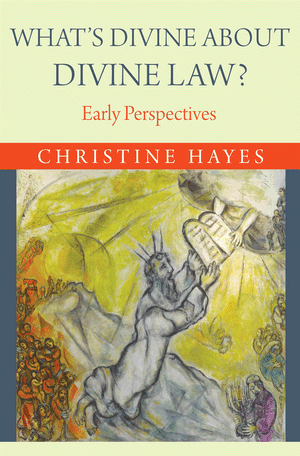
Hayes, What's Divine about Divine Law?

Christine Hayes, What's Divine about Divine Law? -Early Perspectives
Princeton: Princeton University Press, 2015

Contents

Acknowledgments
Abbreviations

Introduction
What's So Divine about Divine Law?
Part I—­Two Conceptions of Divine Law
Parts II and III—Three Responses
 Part II—Mosaic Law in the Light of Greco-­Roman Discourses of Law: Ancient Jewish Responses to the End of the First Century CE
 Part III—The Rabbinic Construction of Divine Law


Part I Biblical and Greco-Roman Discourses of Divine Law
Introduction
1 Biblical Discourses of Divine Law
Introduction
Discourses of the Law
 Discourse 1: Divine Law as an Expression of Divine Will
 Discourse 2: Divine Law as an Expression of Divine Reason
 Discourse 3: Divine Law and Historical Narrative
The Multidimensionality of Biblical Divine Law

2 Greco-­Roman Discourses of Law
Discourses of Natural Law
 Discourse 1: Natural Law and Truth—Logos and Realism
 Discourse 2: Natural Law and Cosmopolitanism
Discourses of Human Positive Law
 Discourse 3: Law and Virtue—the Inadequacy of Positive Law
 Discourse 4: The Flexible, Unwritten, "Living Law" vs. the Inflexible, Written, "Dead Letter"
 Discourse 5: The Opposition of Phusis and Nomos?
 Discourse 6: Positive Law in Need of a Savior
 Discourse 7: In Praise of Written Law—the Mark of the Free, Civilized Man
Additional Literary and Legal Practices: The Juxtaposition of Divine and Human Law
 (8) Divine Law as a Standard for the Evaluation of Human Law
 (9) In the Trenches—Juristic Theory vs. Juristic Practice
 (10) Magistrates and the Equitable Adjustment of Roman Civil Law
Conclusion


Part II Mosaic Law in the Light of Greco-Roman Discourses of Law to the End of the First Century CE
Introduction
3 Bridging the Gap: Divine Law in Hellenistic and Second Temple Jewish Sources
Bridging the Gap
 The Correlation of Torah and Wisdom and the Mutual Transfer of Properties: Sirach, 1 Enoch, and Qumran
 The Correlation of Torah and Reason and the Transfer of Properties: Aristeas, 4 Maccabees, and Philo
Strategies for Negotiating Universalism and Particularism
 Esoteric vs. Exoteric Wisdom: Law’s Narrative in Sirach, 1 Enoch, Qumran, and Philo
Conclusion

4 Minding the Gap: Paul
Paul and the Law
 Genealogical Definition of Jewish Identity: Circumcision and the Law
 Paul’s Discourse of Ambivalence regarding the Mosiac Law
Conclusion


Part III The Rabbinic Construction of Divine Law
Introduction
5 The "Truth" about Torah
What Is Truth?
Measures of Authenticity
 Measure 1: Formal Truth
 Measure 2: Judicial Truth—Human Compromise and Divine Judgment
 Measure 3: Ontological Truth—­Realism vs. Nominalism
The Gaze of the Other
 Rabbinic Self-Awareness: The Motif of Mockery
Conclusion

6 The (Ir)rationality of Torah
Making the Case for the Law's Irrationality
Response 1: Conceding and Transvaluing the Premise
Response 2: Disowning the Premise
Response 3: Denying the Premise—­Rationalist Apologetics
Ta'amei ha-Mitzvot/Ta'amei Torah
Response 4: Splitting the Difference—an Acute Sense of Audience
Conclusion

7 The Flexibility of Torah
Legislative Mechanisms of Change—a Rhetoric of Disclosure?
 Uprooting Torah Law
 Uprooting Torah Law in Light of the Praetorian Edict
Nonlegislative Mechanisms of Change—a Rhetoric of Concealment?
 Modification of the Law—­Internal Values
 Modification of the Law—­External Values
Moral Critique and Phronesis
Conclusion

8 Natural Law in Rabbinic Sources?
Normativity before the Law
 Law Precedes Sinai
 Sinaitic Law Begins at Sinai
 Accounting for Diverse Rabbinic Views on Pre-­Sinai Normativity
The Noahide Laws
 Are the Noahide Laws Invariable, Universal, Rational, and Embedded in Nature?
Conclusion

Writing the Next Chapters
Bibliography
Index of Primary Sources
General Index

http://press.princeton.edu/titles/10509.html

2015年3月11日水曜日

Event: Free access to the 25 most read Religion articles 2014.

Free access to the 25 most read Religion articles 2014.

Taylor &Francis Online opens the 25 top read articles of 2014 from a variety of Routledge journals in the Religion portfolio.

http://explore.tandfonline.com/page/ah/most-read-2015/religion-25-most-read-2015

All the most read articles are free in other subject areas of Arts & Humanities

http://explore.tandfonline.com/page/ah/most-read-2015

All article are free to read until 31 March 2015.


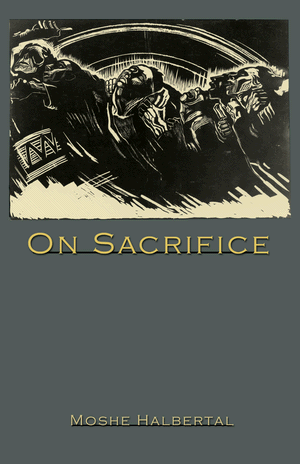
Book: M. Halbertal, On Sacrifice

Moshe Halbertal
On Sacrifice

Princeton: Princeton University Press, 2012

Contents

Introduction

Part 1 SACRIFICING TO
Offering, Rejection, and Ritual
Sacrifice, Exchange, and Love
Sacrifice and Its Substitutes

Part II SACRIFICING FOR
Self-Trancendence and Violence
War and the Sacrificial Logic
Sacrifice and the Political Bond
The State and the Sacrificial Stage

Conclusion

Notes
Index

2015年2月23日月曜日

Symposium: Change of Religious Consciousness under Roman Empire

Symposium
Change of Religious Consciousness under the Roman Empire: Animal Sacrifice and Its Substitutions

2015年3月7日(土) 13:00-18:00
東京大学本郷キャンパス法文1号館219教室
The University of Tokyo, Faculty of Letters, Bldg 1, Room 219

市川裕 Hiroshi Ichikawa, "From Sacrifice to Divine Law: The Formation of the Halakhic Religion of Jews under the Roman Empire"
土居由美 Yumi Doi, "How Early Christianity reacted to Sacrifice in Judaism and Roman sacrificial rituals"
小堀磬子 Keiko Grace Kobori, "Roman sacrifice in the late Republic and under the Empire"
Iskra Gencheva Mikami, "Religio Nova: Sacrifice, State and the Self in Late Antiquity"

コメンテーター Commentator
葛西康徳 Yasunori Kasai
櫻井丈 Joe Sakurai

使用言語 Language: English, German and Japanese
英・独・日

プログラムおよび発表者のレジュメは下記HPより
http://www.l.u-tokyo.ac.jp/ichikawakaken/projects.html

2015年1月15日木曜日

ספר: אברהם מלמד, דת: מחוק לאמונה

אברהם מלמד
דת: מחוק לאמונה

Abraham Melamed, Dat: From Law to Religion
הוצאת הקיבוץ המאוחד
2014

הספר דת: מחוק לאמונה דן בהתפתחות והשתנות המשמעויות שהוטענו במילה הפרסית במקורה 'דת', שחדרה לראשונה לשפה העברית במגילת אסתר. לאורך תקופות ארוכות היה במילה זו שימוש שולי למדי, למשל בתלמוד הבבלי. רק עם ימי הביניים הפך מינוח זה להיות פופולרי, אך הוא שינה משמעות לאורך התקופות. בספרות העברית של ימי הביניים הוא סימן בדרך כלל 'חוק' במשמעו הכולל, כל חוק, לא רק החוק האלוהי אלא גם החוק האנושי. הייתה זו מילה נרדפת ל'תורה' ו'נימוס'; כולם סימנו חוק כפשוטו, על תת הסוגים שלו. באחרית ימי הביניים אף הופיעה הטענה הרדיקלית כי המילה 'דת' מסמנת אך ורק חוק אנושי, ולכן אין זה מן הראוי לעשות בה שימוש כדי לסמן את החוק האלוהי. עם ראשית העת החדשה החלה המשמעות בה שימשה מילה זו להשתנות, זאת בהשפעת המשמעות הנוצרית החדשה שהוטענה במילה הלטינית religio שהפכה להיות ה-  religion  המודרני. תהליך זה מגיע לשיאו בתקופת ההשכלה כאשר המילה העברית 'דת' מסמנת מעתה religion- , ומשנה משמעות מחוק לאמונה. זו המשמעות המודרנית של מילה זו. משמעותה המקורית כ'חוק' נעלמת והולכת, והמילים 'דת' 'תורה' ו'נימוס', שהיו עד כה מילים נרדפות, מקבלות כל אחת משמעות שונה והולכות לדרכן הנפרדת. התפתחות לשונית זו באה היטב לידי ביטוי במילונאות המודרנית. בתקופתנו מקבלת המילה 'דת' משמעות אמורפית יותר ויותר והיא משמשת לתיאור כל תפיסת עולם מחייבת, גם כזו שאין לה שום הקשר תיאולוגי. שינויי המשמעות של המילה 'דת' לאורך ההיסטוריה, הנסקרים בספר זה, מדגימים היטב את השינוי המשמעותי שעברה היהדות המודרנית מדת המתבססת על חוק לדת המתבססת על אמונה. 

2014年4月25日金曜日

XXI. World Congress of the International Association for the History of Religions

Call for paper:
XXI. World Congress of the International Association for the History of Religions
August 23-29, 2015, Erfurt, Germany

Proposals for panels: until September 14, 2014
Proposals for individual papers: until December 15. 2014

http://www.iahr2015.org/iahr/1026.html


2013年8月17日土曜日

On Common Ground

On Common Ground

The Pluralism Project
(Harvard University)

Introduction to the situation of religious variety in the U.S.

http://www.pluralism.org/ocg/


2013年3月12日火曜日

Scripture and Interpretation: Reading List

Scripture and Interpretation

David Satran and Miriam Goldstein
Dep. of Religious Studies, 2012-13
The Hebrew University of Jerusalem

1. Saint Augustine, Confessions, Book 12:32-34
2. Erich Auerbach, Mimesis, Ch.1: Odysseus' Scar
3. Wilfred Cantwell Smith, "Scripture as Form and Concept: Their Emergence for the Western World," (Miriam Levering ed. Rethinking Scripture, Ch. 2; cf. W.C. Smith, What is Scripture?, Ch. 3)
4. Letter of Aristeas
5. Philo of Alexandria, On the life of Moses, Book II, L. 34-42
6. Philo of Alexandria, On the Creation of the World
7. Philo of Alexandria, On the Contemplative Life
8. Gerald L. Bruns, "Midrash and Allegory: The Beginnings of Scriptural Interpretation" (R. Alter and F. Kermode ed. The Literary Guide to the Bible, Cambridge, Mass.: Harvard University Press, 1982)
9. Origen, On the Principles, 1, Preface 2-3, 10
10. Origen, Commentary on Psalms 1-25
11. Hava Lazarus-Yafeh, Intertwined World, Princeton: Princeton University Press, 1992
12. Robert Brody, Rav Se'adya Gaon, Jerusalem: The Zalman Shazar Center
13.


to be continued...